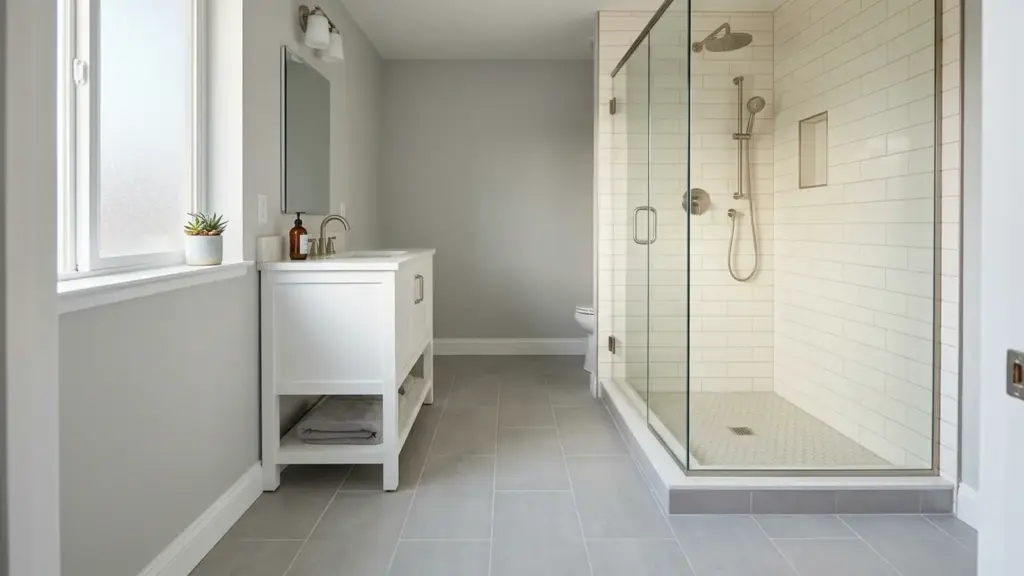
For a busy family bathroom in Westminster, Elite Property Innovations considers porcelain the most durable bathroom tile, at a middle-of-the-road price, and the industry standard defines porcelain as tile with a water absorption of 0.5% or less. Ceramic is typically the most affordable choice, while natural stone costs the most and needs routine sealing so it doesn’t stain or discolor. The right pick depends on where the tile goes, who uses the room, and how much upkeep you want.
Elite Property Innovations installs tile as part of its bathroom remodels, including floor-to-ceiling tile, decorative mosaics, large-format porcelain, and heated floors. This guide shares how Elite Property’s team thinks about tile, along with the industry standards behind words like “porcelain” and “slip-resistant.”
Ceramic, Porcelain, and Natural Stone in Plain English
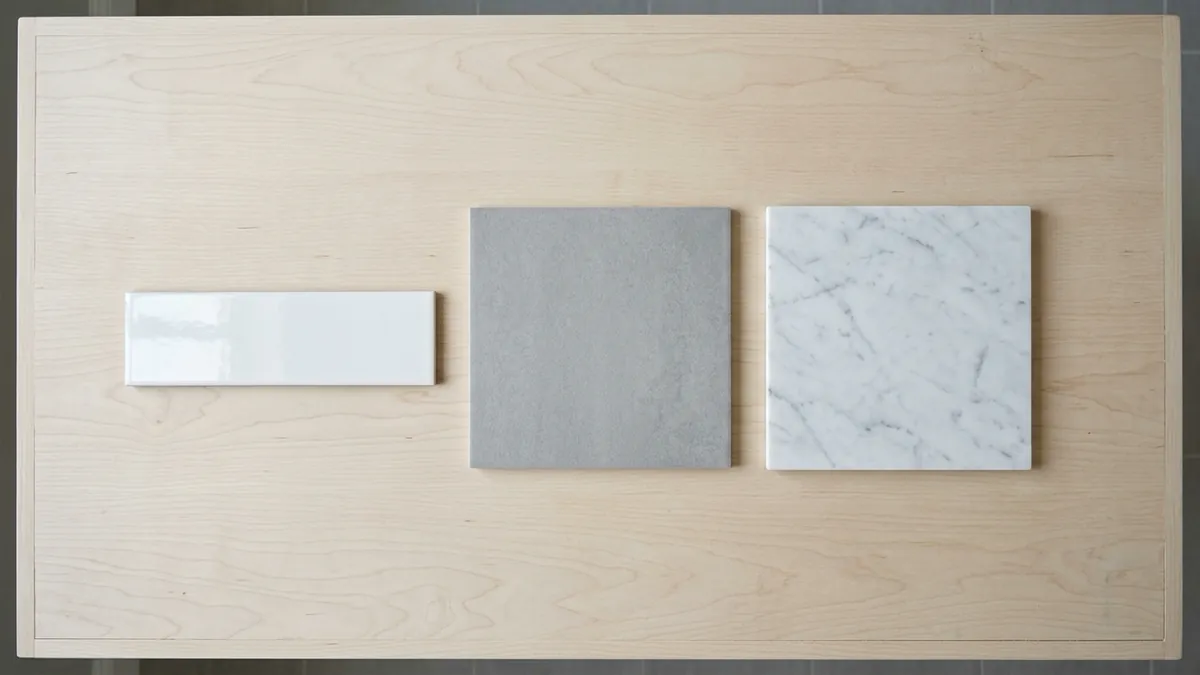
The three main bathroom tile families differ mostly in price, density, and upkeep. Here’s how Elite Property Innovations explains them to homeowners:
- Ceramic is typically the most affordable tile.
- Porcelain is the most durable, and it lands in the middle on price.
- Natural stone is the most expensive, and it needs routine sealing so it doesn’t stain or discolor over time.
The technical difference between ceramic and porcelain is how much water the tile absorbs. Under the industry standard, porcelain tile has a water absorption of 0.5% or less, and non-porcelain tile absorbs more than that, according to the Tile Council of North America (TCNA). Lower absorption is one reason porcelain suits a wet room so well.
| Ceramic | Porcelain | Natural stone | |
|---|---|---|---|
| Price, in Elite Property’s experience | Most affordable | Middle of the road | Most expensive |
| Water absorption | More than 0.5% | 0.5% or less | Not covered by the porcelain standard; ask about sealing |
| Durability | Durable glazes, but glaze hardness varies by product | Unglazed porcelain is harder than granite, per TCNA | Varies; acid-sensitive stones can etch |
| Upkeep | Grout needs care; many cement grouts need sealing (per one grout maker’s guidance) | Grout needs care; many cement grouts need sealing (per one grout maker’s guidance) | Routine sealing; sealing makes stone stain resistant, not stain proof |
| Best fit | Budget-minded projects; check the glaze rating before using it on a floor | Floors, shower floors, and large-format looks | Homeowners ready to keep up with sealing and gentle cleaners |
Houzz’s 2025 Bathroom Trends Study shows where homeowners land. Porcelain was the most popular material for floors outside the shower (39%), followed by ceramic (26%), with marble at 8%.
How to Tell Porcelain From Ceramic
A Porcelain Tile Certification Agency (PTCA) mark on the tile means it has been certified as true porcelain, according to TCNA. The agency also notes that some tile sold as porcelain doesn’t meet the standard, so the signs are worth looking for.
Porcelain comes glazed and unglazed. Unglazed porcelain is often called “through body” because the color runs all the way through, and TCNA describes it as harder than granite, so wear doesn’t show the way it can on a surface glaze. Glazed porcelain is usually a little easier to clean, while unglazed porcelain may have better slip resistance.
Ceramic has other benefits. Many ceramic glazes are very durable, but TCNA says glaze hardness varies from product to product, so check that a ceramic tile is rated for the “area of use” before putting it on a floor.
Bathroom Floors and Shower Floors: Start With Slip Resistance
The first thing to check for any bathroom floor tile is its slip-resistance rating. Under the ANSI A326.3 standard, hard-surface flooring is classified by where it can be used, and the “Interior, Wet” class covers level indoor floors that get wet, with a wet DCOF (dynamic coefficient of friction) of 0.42 or higher or a manufacturer’s declaration. Ask to see that rating on the product sheet for any tile headed for your bathroom floor.
Homeowners are paying attention to it. In the Houzz study, 29% of homeowners chose nonslip flooring outside the shower, and 20% chose heated flooring. Elite Property installs heated floors as part of its tile and flooring work, which takes the chill off tile on a Colorado winter morning.
Shower floors are a separate decision from the rest of the room. Tile is the most common shower floor by far, chosen by 79% of renovating homeowners in the Houzz study, and porcelain (39%) and ceramic (26%) lead the materials.
Size matters even more in the shower. Most homeowners (61%) still choose small tiles, from 1 by 1 inch up to 4 by 4 inches, for the shower floor, though that share fell 4 points, while extra-large tiles of 24 by 24 inches or more rose 2 points to 6%. Mosaic tiles are rated for slip resistance by the manufacturer’s declaration under ANSI A326.3, so the product sheet is still the place to look.
If you’re replacing a tub with a shower at the same time, Elite Property’s walk-in shower conversion guide covers what that project involves.
Large-Format Tile Means Fewer Grout Lines, Flatter Surfaces
Elite Property Innovations sees many homeowners choose large-format tile to cut down on grout lines, which means less grout to clean over the years. Porcelain gives you the biggest variety of large-format options.
Big tiles do ask more of the floor or wall underneath. For tiles with at least one edge of 15 inches or longer, the ANSI installation standard allows no more than 1/8 inch of variation in 10 feet, and no more than 1/16 inch in 2 feet, according to the Ceramic Tile Education Foundation. The allowable lippage (one tile edge sitting higher than its neighbor) on a narrow grout joint is just 1/32 inch, about the thickness of a credit card.
If you’re choosing tiles with an edge of 15 inches or more, ask your installer how they’ll check and correct the flatness of your floor or wall before the tiles go down, since that prep keeps the edges even. Tile sizes have grown from the old 8 by 8 inch standard to 12 by 24, 24 by 48, and beyond, so many large-format choices fall in that range.
Porcelain is gaining ground outside the shower too. In the Houzz study, 13% of homeowners chose porcelain for walls outside the shower, up 3 points, compared with 12% for ceramic, while paint still led at 71%.
Grout, Sealing, and Westminster’s Hard Water
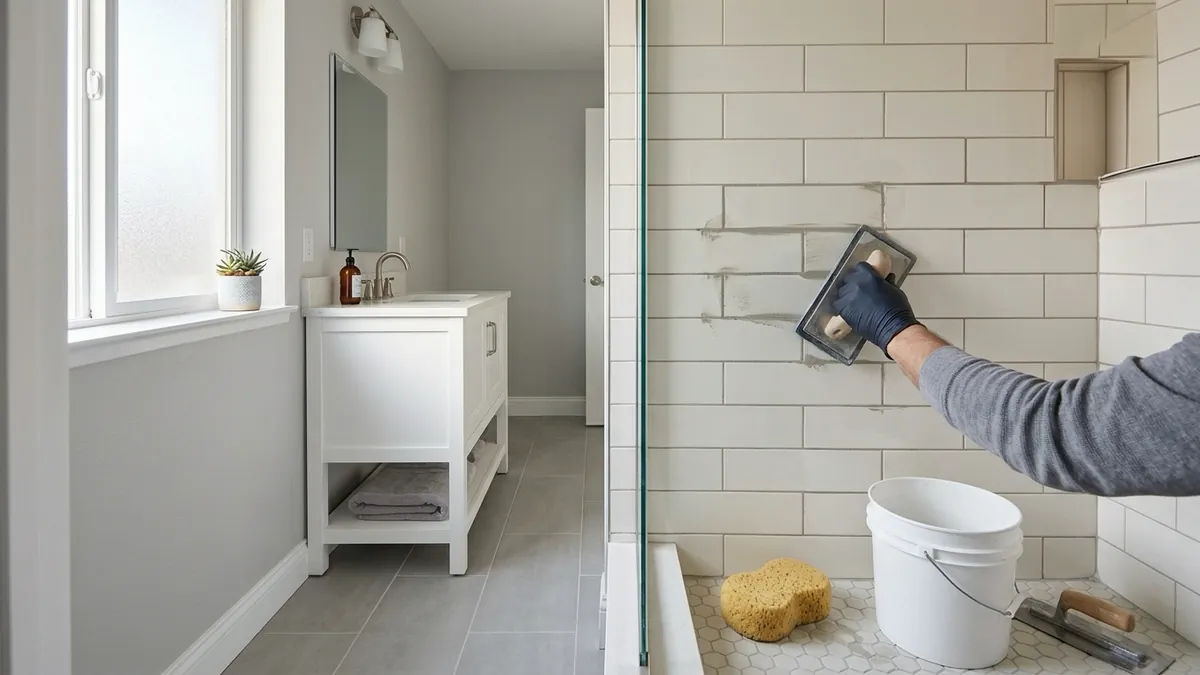
Many cement grouts need sealing, so follow the grout maker’s instructions for your product. One major grout manufacturer’s technical guidance describes standard cement grout as porous, able to absorb water and stains, and in need of regular sealing to keep its water resistance.
The same guidance says epoxy grout is non-porous, resists water and stains, and doesn’t usually need sealing, which suits showers, though it typically costs more.
Natural stone needs sealing of its own. The Natural Stone Institute explains that stone sealers work as repellents, and that sealing makes stone more stain resistant without making it stain proof. Elite Property Innovations tells homeowners that natural stone takes routine sealing to keep it from staining or discoloring over time.
Water hardness in Westminster adds a local reason to plan for upkeep. The City of Westminster’s 2026 water quality report lists total hardness at 112 to 152 parts per million, or about 7 to 9 grains per gallon. The U.S. Geological Survey classifies 61 to 120 mg/L as moderately hard and 121 to 180 mg/L as hard, so Westminster’s water runs from moderately hard to hard.
The USGS notes that hard water leaves spots and film behind. The Natural Stone Institute warns that products containing lemon, vinegar, or other acids can dull or etch calcareous stones such as marble, and it recommends mild, non-acidic cleaners. Its simplest tip is a squeegee after each shower to keep soap scum down.
Picking the right tile for a small room is its own puzzle, and Elite Property’s small bathroom remodel ideas cover where tile spending makes the most difference.
What to Ask Before the Old Tile Comes Out
Before you pick a tile, we need to talk about what’s happening under it. A tile choice is only as good as the surface, the waterproofing, and the installation behind it, so talk with your installer about all three.
- Does my project need a permit? Westminster’s permit list says floor covering doesn’t need a permit, while remodeling and any changes to plumbing, electrical, or structural systems do. The city also suggests checking with your HOA first.
- How will you waterproof the shower? Colorado’s plumbing rule treats shower wall and shower floor construction as information-only sections that aren’t subject to plumbing licensing, permitting, or inspection. That makes your installer’s waterproofing method worth asking about directly.
- Could the old floor contain asbestos? The Colorado Department of Public Health and Environment lists floor tiles and adhesives among the building materials that could contain asbestos before the 1990s, and the only way to know is to test. In an older home, ask about testing before the old floor comes up.
- Is this tile rated for where it’s going? Check the manufacturer’s area of use and the slip-resistance class on the product sheet.
At Elite Property Innovations we believe that proper waterproofing is critical in a bathroom. If you’re weighing a new tile against a bigger project, Elite Property’s guide to choosing a full remodel or a refresh can help you decide.
We are based right here in Westminster and are one of the local remodeling contractors in Westminster, CO homeowners can call for help choosing and installing tile. You can see the full scope of Elite Property’s shower and tile installation work, along with vanities, walk-in showers, and tub-to-shower conversions, on its bathroom remodeling page.
FAQ
What type of tile is best for a bathroom floor?
Elite Property Innovations considers porcelain the most durable tile for a bathroom floor, at a mid-range price, and TCNA describes unglazed porcelain as harder than granite with a water absorption of 0.5% or less. Choose a tile rated “Interior, Wet” under ANSI A326.3 for slip resistance. Ceramic can work on floors too, as long as the manufacturer rates its glaze for floor use.
Should I use the same tile for the bathroom floor and shower?
You can, though most homeowners pick small tiles for the shower floor: 61% chose tiles 4 by 4 inches or smaller in Houzz’s 2025 study. If you want one continuous look, choose a porcelain line that comes in several sizes and confirm each one’s slip-resistance rating.
What is the disadvantage of porcelain tiles?
Porcelain is harder to cut and harder to bond than ceramic, according to TCNA, which matters to the installer more than the homeowner. Large-format porcelain also needs a very flat floor or wall, and the grout between porcelain tiles still needs care.
What tiles should not be used in a shower?
Avoid any tile the manufacturer doesn’t rate for wet areas or for floors, and check the slip-resistance class before using a tile on a shower floor. Acid-sensitive natural stones like marble can be used, but they need sealing and non-acidic cleaners, which takes more work in a hard-water area like Westminster.
Do I need a permit to retile a bathroom in Westminster?
Westminster’s permit list says floor covering doesn’t need a permit, but remodeling does, and so do changes to plumbing, electrical, or structural systems. Because the city’s list isn’t complete, check with the Westminster Building Division about your exact project.
Ready to Pick Your Tile?
Tile is one of the most visible choices in a bathroom remodel, and it’s easier with someone walking you through the options. Elite Property Innovations helps Westminster homeowners weigh ceramic, porcelain, and natural stone against how the room is used and how much upkeep fits their life.
Send us photos of your bathroom and we’ll give you a rough quote, then we’ll schedule a consultation if it’s a good fit.