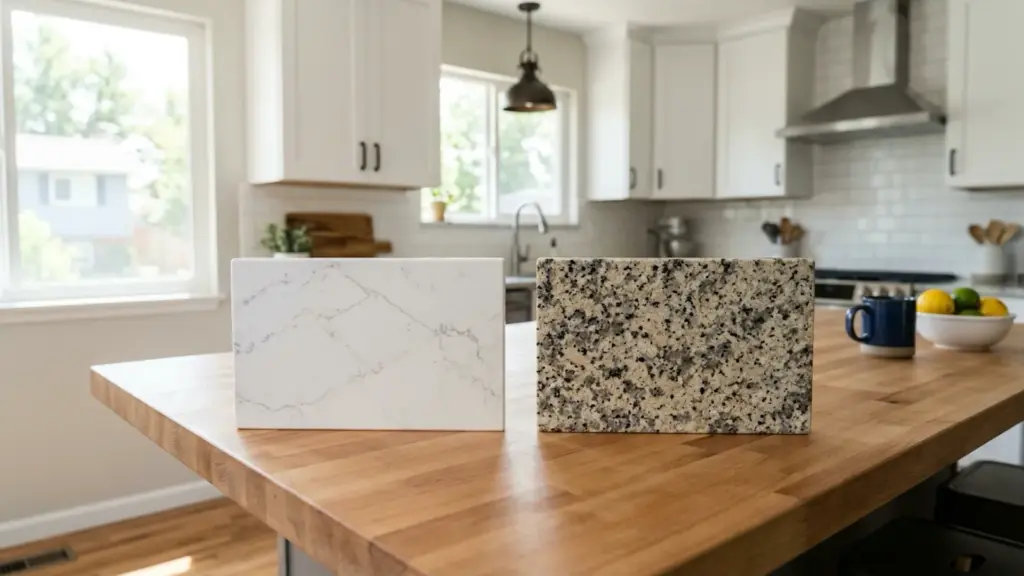
Quartz and granite are both durable, good-looking countertops. At Elite Property Innovations, which installs both for Arvada homeowners, we find the choice comes down to two things: the look you want in your kitchen and how you use it every day. Quartz is an engineered, consistent, low-upkeep surface, while granite is natural stone with one-of-a-kind patterns.
This guide compares quartz and granite on durability, upkeep, and looks, so you can walk into your remodel already knowing what matters to you.
What’s the Difference Between Quartz and Granite?
Quartz countertops are engineered stone, made from about 94% ground quartz bound with polyester resins and colored with pigments, according to This Old House. The slab is manufactured, so the color and pattern are set at the factory.
Granite is natural stone cut from the earth. It is an igneous rock that formed as magma cooled slowly underground, and it is made mostly of quartz and feldspar with smaller amounts of mica and other minerals. Colorado has a famous example: Pikes Peak is one of the best-known natural granite formations in the world.
In the stone trade, “granite” is a broad label. Geology.com notes that rocks like gabbro, gneiss, and diorite are also sold as granite, so two “granite” slabs can behave a little differently. Ask about the specific stone you are looking at.
Engineered quartz has held the top spot among countertop materials chosen by renovating homeowners for longer than a decade. In the 2025 U.S. Houzz Kitchen Trends Study, 39% of renovating homeowners chose engineered quartz and 19% chose granite, with quartzite at 11%.
Which Holds Up Better to Everyday Family Use?
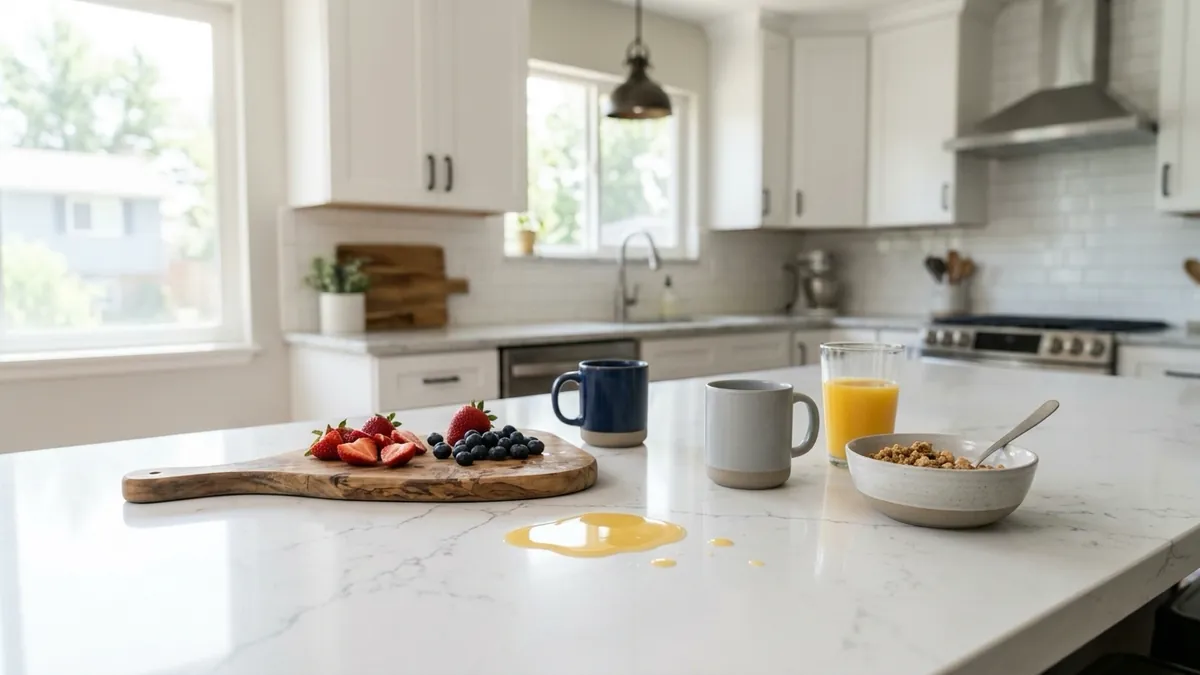
Both materials hold up well in a busy family kitchen, and their weak spots are different. Quartz handles stains and spills better, while granite handles heat better.
Scratches and chips. Both surfaces are hard. Quartz, the mineral that makes up most of an engineered quartz slab, rates 7 on the Mohs hardness scale, and feldspar, the other main mineral in granite, rates 6. A quartz manufacturer’s care guide still warns that metal knives may scratch quartz, so a cutting board is the rule for both.
Heat. Heat is quartz’s main weakness. One quartz manufacturer’s care guide says direct heat can damage the surface and recommends trivets under hot cookware. This Old House notes that quartz can crack or discolor under extreme or prolonged heat. Granite tolerates heat better, although the Natural Stone Institute still recommends trivets or mats on natural stone.
Stains. Quartz is nonporous, so spills stay on the surface. Granite resists most acids found in a kitchen, because it is a siliceous stone made mostly of silicate minerals like quartz and feldspar. Granite can still stain from oil: the Natural Stone Institute notes that an oil-based stain darkens the stone, so blot spills quickly.
Sun. If your kitchen gets strong direct sunlight, keep in mind that This Old House notes UV exposure can cause quartz to fade over time.
The way your household cooks points toward the better countertop for you. If you often pull pans straight from the oven or stovetop and set them down near the range, granite is the more forgiving surface, though using a trivet is still a smart habit.
If your Arvada kitchen sees a steady stream of juice, coffee, and after-school snacks, and you would rather wipe up and move on, quartz’s nonporous surface makes daily life a little easier. Either way, a trivet by the stove takes most of the heat question off the table, which leaves the look as the deciding factor.
What Does Upkeep Look Like?
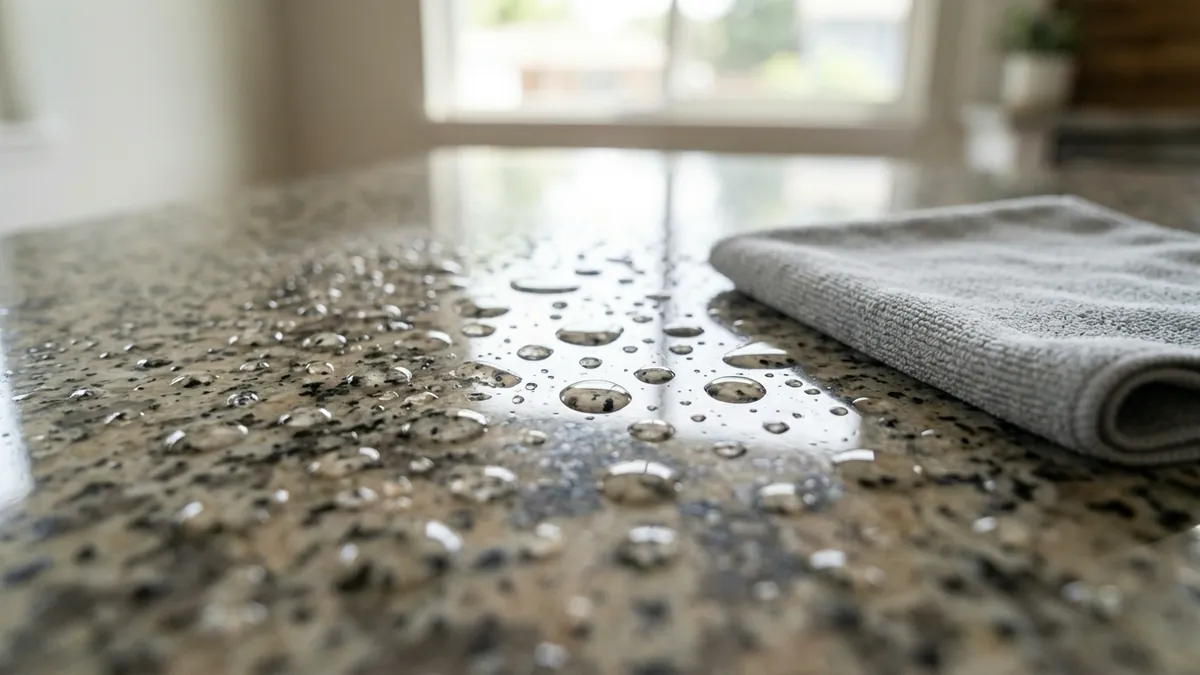
Quartz needs the least upkeep, because it never needs sealing and mild soap, water, and a soft cloth handle daily cleaning. One quartz manufacturer’s care guide advises against bleach-based cleansers and abrasive scouring pads.
Granite takes a little more attention, mostly around sealing. The Natural Stone Institute explains that stone “sealers” are really impregnating repellents, and that sealing makes stone more stain resistant without making it stain proof. It also notes that many stones do not require sealing at all, although sealing is common practice. Your installer can tell you whether the slab you choose needs it and how often. For daily cleaning, the institute recommends a neutral stone cleaner or mild dish soap and warm water, and blotting spills right away.
If you would rather never think about your countertop, quartz is the easier fit. If you don’t mind a few minutes of care now and then, granite’s upkeep is modest.
Which Look Fits Your Kitchen?
Quartz gives you a consistent, predictable surface, which suits a kitchen designed around a clean, uniform color. This Old House describes quartz as more consistent in appearance than granite.
In our view, that consistency is also quartz’s tradeoff. Quartz is an extremely durable product, but it is man-made, so it will not give you the natural, beautiful inconsistencies you find in granite or in quartzite, a natural stone formed when sandstone is put under extreme heat and pressure.
Every granite slab is different, so it pays to see the full slab in person before it is cut, since a small sample cannot show the whole pattern.
These questions can help you settle the look:
- Do you want the counter to quietly support the rest of the kitchen, or to be the focal point?
- Are you drawn to a solid color or subtle veining, or to bold movement and natural variation?
- Do you cook with a lot of heat and set pans down fast, or do you mostly prep and serve?
Buyers like natural stone, too. In the National Association of Home Builders’ 2024 What Home Buyers Really Want survey, 73% of buyers rated a granite or natural stone countertop as essential or desirable.
Quartz vs. Granite at a Glance
Quartz and granite differ most on look, heat tolerance, and upkeep, as the table below shows.
| Quartz (engineered) | Granite (natural stone) | |
|---|---|---|
| What it is | About 94% ground quartz with resins and pigments | Natural igneous rock, mostly quartz and feldspar |
| Look | Consistent color and pattern | Unique slab-to-slab variation |
| Heat | Can be damaged by direct heat; use trivets | More heat resistant; trivets still recommended |
| Stains | Nonporous | Resists most kitchen acids; sealing improves stain resistance |
| Sealing | Never needed | Sometimes needed, depending on the stone |
| Daily cleaning | Mild soap and water; no bleach cleansers | Neutral stone cleaner or mild dish soap |
| Price | Starts at a similar point; slightly lower on average | Starts at a similar point |
This Old House says both materials start at similar price points, with quartz averaging slightly cheaper, so the slab you fall in love with matters more than the category. For a fuller look at budgets, see our guide to what affects the price of a kitchen remodel.
Do Granite Countertops Raise Radon Levels?
Granite countertops are very unlikely to be a meaningful radon source. The EPA says radon from the soil under a home is a far larger risk than radon from granite. The EPA also says radiation from granite countertops is extremely unlikely to raise annual doses above normal background levels.
Soil radon is the real Colorado issue. The Colorado Department of Public Health and Environment reports that about half of Colorado homes exceed the EPA’s action level of 4.0 pCi/L for radon, so this can truly be a good question. Whichever countertop you choose, it won’t have much bearing on your radon test results, but testing your home for radon is worth doing regardless.
Choosing Countertops for an Arvada Kitchen
The median year built for Arvada homes is 1980, according to U.S. Census Bureau data for 2024, and about half of the city’s homes were built before then. In an older kitchen, a countertop change may come with other decisions, like whether to reface or replace your cabinets, or whether a refresh or a full remodel fits your kitchen.
Permits are also worth a quick check. The City of Arvada lists interior remodels, including kitchens, among the projects that need a residential interior permit, so ask the city or your contractor how your project’s scope is classified before work starts.
Elite Property Innovations serves Arvada and surrounding communities, and you can learn more about our home remodeling in Arvada work. We provide countertop installation for both granite and quartz, and the right surface for your kitchen comes down to the look you want and how your household uses the room. Send us photos and we’ll give you a rough quote, then we’ll schedule a consultation if it’s a good fit.
FAQ
Which is better quality, quartz or granite countertops?
Neither quartz nor granite is better quality across the board; both are durable countertops. Quartz is nonporous and never needs sealing, while granite handles heat better and offers natural, one-of-a-kind patterns.
What is the downside of quartz countertops?
The main downside of quartz countertops is heat sensitivity. One quartz manufacturer’s care guide says direct heat from hot cookware can damage quartz and recommends trivets. This Old House notes that strong UV exposure can cause fading over time. Quartz is also man-made, so it lacks the natural variation of granite or quartzite.
Do granite countertops need to be sealed?
Some granite countertops benefit from sealing and some do not need it, depending on the stone. The Natural Stone Institute says many stones do not require sealing, and that a sealer makes stone more stain resistant without making it stain proof. Quartz never needs sealing, so it is the lower-upkeep choice of the two.
Can I put a hot cup of coffee on quartz?
Use a trivet under anything hot on quartz, including a hot coffee pot. One quartz manufacturer’s care guide recommends trivets or heating pads under hot cookware and coffee pots, because direct heat can damage the surface.